Thanks to Bees, Resin Becomes Propolis
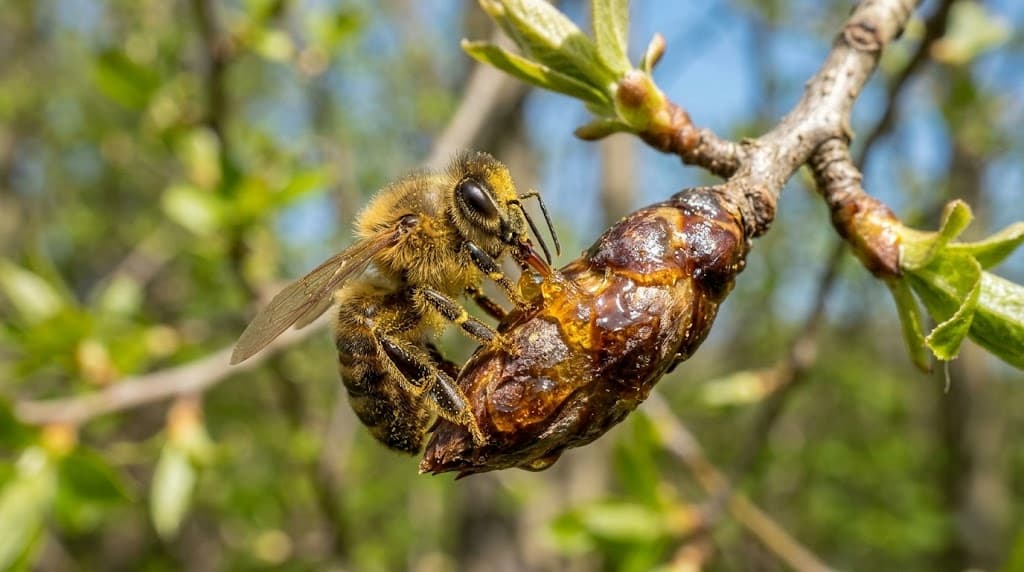
It is originally a resinous substance secreted by poplar buds to protect themselves from external aggressions (fungi, bacteria, viruses, rotting...). Bees harvest this resin, transport it in their pollen baskets during flight, transform it, and use it as:
CEMENT to glue elements together, seal cracks, reduce the entrance hole, and better monitor passage.
THERMAL INSULATION to maintain a constant temperature within the brood.
ANTISEPTIC TREATMENT of the wax cells before the queen lays her eggs, which thus takes place in a very clean environment.
EMBALMING to eliminate any danger of potential infection in the event of an intrusion into the hive - a mouse, for example - and the impossibility of removing it.
Each botanical species produces organic compounds—polyphenols—that play a role in its defense mechanisms. As a result, each type of propolis has its own distinctive polyphenol profile. Some are highly complementary and act on the same targets (such as brown poplar propolis and green Baccharis propolis, for example). Combining them can help maximize their effects. More than 300 compounds have been identified in poplar propolis, mostly polyphenols:
- FLAVONOIDS: flavones (apigenin, chrysin, luteolin) and flavonols (galangin, kaempferol).
- OTHER PHENOLIC COMPOUNDS: aromatic acids and esters of aromatic acids.
Propolis: A Source That Needs to Be Monitored
Major Health Indications of Poplar Propolis
Antimicrobial Activity
The bactericidal action of propolis and its components is one of its most documented characteristics. It stands out due to its broad spectrum of action, affecting both Gram+ and Gram– bacteria, although its effectiveness is significantly higher against Gram+ strains. Propolis inhibits a wide variety of microorganisms responsible for various pathologies:
One of the most promising areas of research concerns the interaction of propolis with conventional treatments. Studies show that propolis remains effective against certain bacterial strains that have developed multi-resistance to classic antibiotics. It is also thought to increase the effectiveness of certain antibiotics (such as streptomycin or ampicillin) when administered as a supplement, allowing for an enhanced therapeutic action.
Antiviral Activity
Numerous studies highlight the antiviral potential of propolis and its constituents against various pathogens (myxoviruses, adenoviruses, etc.). More specifically, apigenin and chrysine exert a prophylactic role against influenza by targeting neuraminidase. Regarding HIV, poplar propolis, via caffeic acid phenethyl ester (CAPE), acts as an anti-integrase agent and enhances the effectiveness of conventional antiretroviral treatments like AZT. Finally, its clinical use in cream form has proven conclusive in limiting the duration and frequency of outbreaks of oral or genital herpes.
Antifungic Activity
Propolis is distinguished by its broad spectrum of action against fungal microorganisms. Its effectiveness relies on two pillars:
- A direct action: propolis has proven fungicidal virtues against yeasts and pathogenic genera such as Candida, Aspergillus, and Microsporum.
- An indirect action (immunomodulation): in vitro research shows that propolis works in synergy with the immune system. Notably, it stimulates macrophage activity, thereby strengthening their capacity to eliminate specific fungal strains.
Antioxidant Activity
Propolis is a substance composed of numerous antioxidant compounds: vitamins E and C, and polyphenols. There is a direct correlation between the concentration of phenolic compounds and the antioxidant capacity of the product. Because of this, poplar propolis, being richer in polyphenols, possesses a higher antioxidant potential than Brazilian green propolis, for example. In the same spirit, it has been proven that the whole resin is more effective than its components taken separately (higher ORAC value).
Within the organism, propolis acts on two fronts: it slows down the degradation of fats (lipid peroxidation) in vital organs and stimulates our own enzymatic defenses. To date, caffeic acid (CAPE) remains its most antioxidant constituent.
Anti-inflammatory Activity
The effectiveness of propolis against inflammation, whether acute or chronic, has been proven in several animal models. It acts in two main ways:
- Action on the immune system: it slows down the activation of molecules such as interleukin 6 (IL-6).
- Enzymatic action: it blocks the work of several enzymes (cyclooxygenase, lipoxygenase...) that are essential to the inflammatory process.
Caffeic acid phenethyl ester (CAPE) is the most efficient at regulating the transformation of arachidonic acid, thereby preventing the formation of substances responsible for pain and inflammation (leukotrienes and prostaglandins).
Other Effects of Propolis
Beyond its traditional virtues, propolis acts as a true natural shield:
- Hematological support: propolis exerts a preventive effect against the drop in blood cells (neutropenia, anemia, thrombocytopenia) induced by heavy treatments such as chemotherapy or radiotherapy.
- Protection of vital organs: in vitro and in vivo studies confirm its ability to reduce the toxicity of certain chemical agents and pollutants (heavy metals, xenobiotics such as paracetamol) on the liver, heart, kidneys, and neurons.
- Mechanisms of action: its effectiveness relies on its antioxidant properties, which promote DNA repair and strengthen endogenous defenses (notably by maintaining glutathione levels and stimulating protective enzymes).
- Metabolic regulation: research on animal models also indicates an action against insulin resistance. This effect is explained by better regulation of glucose and lipid metabolism, as well as a reduction in inflammation (inhibition of IL-1β and NO synthase).
 Français
 English