When Stress Takes Center Stage
The transition out of winter is a period highly conducive to seasonal blues. In winter, we see less light. Yet, light is a source of energy for every one of us. When our body struggles to cope, it becomes deeply fatigued, sometimes even showing symptoms of depression. Whatever the season, fatigue in its various forms is a warning sent by the body demanding a break!
Normal fatigue is physiological and muscular. It generally occurs after physical exertion, prolonged stress, or a lack of sleep. It most often disappears after much-needed rest.
Organic fatigue, also known as asthenia, most frequently manifests alongside an underlying pathology such as a nutrient deficiency, an infection, or a progressive disease. It can also be linked to irregular work hours that interfere with biological rhythms.
Nervous fatigue is characterized by the fact that it no longer yields to rest alone. It is accompanied by insomnia or, conversely, hypersomnia, and is most prominent upon waking. It signals an imbalance in the central nervous system following excessive demand. This can lead to the onset of: depression, fibromyalgia, chronic fatigue syndrome, a drop in libido and overall energy, and an inability to put forth physical and mental effort.

Statistical observations of fatigue reveal that overall, 39% of fatigue cases have an organic cause, 41% a psychological cause, 10% a mixed cause, and 10% undetermined causes. The imaginary invalid does not exist. Fatigue in all its forms is a warning sent by the body demanding a break!
In all cases, it is important to remember that fatigue leads to an accumulation of lactic acid and other metabolic waste in the muscles and the entire body. Permanent fatigue undoubtedly stems from this build-up of toxins. Before thinking about toning the body, it is preferable to cleanse it.
Pampering Your Liver with Chestnut Pollen
Thanks to its antioxidant potential, chestnut pollen has hepatoprotective effects, meaning it helps clear the liver of fat. It is rich in fiber (>13 g/100 g), including insoluble fiber which, by absorbing water, increases stool volume, thus helping to regulate and rebalance intestinal function. Since the intestine is one of the main organs contributing to the elimination of toxins from the body, it is therefore important for it to be in a good physiological state.
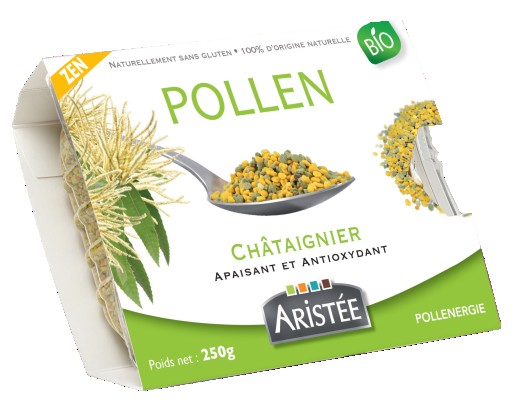
Chestnut pollen also contains selenium, which actively participates in the detoxification of xenobiotics—low molecular weight molecules that are foreign to the body (medications, water pollutants, food additives, certain natural food compounds, etc.). Selenium is part of the structure of several antioxidant enzymes: glutathione peroxidases and thioredoxin reductase. These enzymes help neutralize the excess of free radicals present in the body.
Did you know? A congested liver is often the main cause of allergies. An allergy is always a manifestation of elimination by the body which, when overwhelmed, reacts too strongly and excessively to the slightest aggression.
Detoxify the body with bee pollen
Revitalizing the Body with Pollen
Thanks to its concentration in plant proteins, fibers, vitamins, minerals, and trace elements, fresh pollen helps reduce fatigue, boost the body, and improve its resilience. Raw pollens have a protein content between 15% and 25% depending on their botanical origin. This content is higher than all plant sources, and even some animal sources like eggs! These plant proteins are of excellent quality, with very beneficial levels of Essential Amino Acids (EAAs): stimulating protein synthesis, modulating inflammatory states, and improving the condition of the intestinal mucosa...

Pollens are also rich in B-group vitamins. They play a major role in energy production and the health of the nervous system. Beyond physical problems, their deficiency inevitably leads to numerous nervous and behavioral dysfunctions. They are often altered by food preservation and cooking conditions, which makes their presence in industrial food particularly unpredictable!
| B Vitamins |
Role in Nervous Balance |
Richest Pollens |
| B1 |
Effect on depression and fatigue |
willow / fruit willow / hawthorn |
| B3 |
Effect on the propagation of nerve impulses and a significant effect on mood |
cherry / willow / fruit willow / fortifying kidoupollen |
| B5 |
Helps the proper functioning of the nervous system. Anti-stress action |
willow / fruit willow / fortifying kidoupollen / chestnut |
| B6 |
Anti-stress and anti-depressant action |
hawthorn / chestnut |
| B9 |
Promotes emotional balance |
cherry / hawthorn |
- Fresh frozen hawthorn pollen, rich in vitamin B6, has an anti-stress and anti-depressant action that is essential for the formation of thoughts, emotions, and coordination. It is also rich in tryptophan, the precursor to serotonin, also known as the good mood hormone.
- Frozen chestnut pollen is a source of potassium and rich in vitamins B2 and B3, which contribute to the normal functioning of the nervous system. Stress stimulates energy metabolism and, as a result, creates an extra need for vitamins B2 and B3 to meet this stimulation. A deficiency in these vitamins can lead to disruptions in the normal functioning of the nervous system. Chestnut pollen is also rich in vitamin B6, which contributes to normal psychological functions, and it provides the body with tryptophan, an amino acid precursor to serotonin. This hormone is involved in regulating mood and anxiety.
In case of a drop in energy, cherry bee pollen helps to recharge and clear signs of fatigue by providing boosting nutrients such as vitamin C. Cherry pollen is particularly suited for revitalizing from within, with visible beneficial effects on skin radiance and the quality of hair and nails.
Action of Royal Jelly on Fatigue
Taking royal jelly is not limited to the winter period! Contrary to some popular misconceptions, this product does not strengthen the immune system. In the hive, as well as for therapeutic use, this role is dedicated to propolis and its antiseptic properties. Royal jelly is a concentrate of minerals (calcium, iron, potassium), trace elements, and vitamins. In fact, it is the richest known natural product in vitamin B5! As an adaptogen, royal jelly supports the body when facing situations likely to disrupt it and helps to restore a good energy level.

Rich in Vitamin B5
Pantothenic acid has a very powerful stimulating action that helps the proper functioning of the nervous system. Royal jelly thus helps to regain a good energy level in case of exhaustion. It promotes relaxation when stressed. As an adaptogen, royal jelly helps the body cope as best as possible with various situations likely to disrupt its functioning.
Rich in Acetylcholine
Acetylcholine is a neurotransmitter present in the brain, spinal cord, and all areas of the nervous system. Royal jelly contains this substance, which helps improve memory and makes our intellectual capacities more efficient. It will boost the transmission of nervous information, which is responsible for concentration and memory!
Ideal for preventing drops in physical or intellectual energy, a 20 to 40-day course of fresh royal jelly is highly recommended in combination with pollen intake.
 Français
 English