Français
 English

Subtotal
€0.00
Checkout
Why choose fresh pollen?
The bees' living superfood
Les pollens transportés par les insectes pollinisateurs sont des aliments d’une extraordinaire complexité. Chaque grain de pollen est porteur de vie ! Pour mener à bien leur mission de reproduction, la nature les a équipés d’atouts nutritionnels exceptionnels. Les abeilles magnifient, enrichissent ce complexe de substances toutes aussi importantes et bénéfiques aux organismes humains.
Bee Pollen, a Little Gem of Nature
Pollen grains contain the male seeds of plants. They therefore bear the heavy responsibility of their reproduction! To successfully carry out this mission, plants have endowed them with precious macro and micronutrients to make them attractive, indestructible, and carriers of life.
A Food Produced by Plants…
To protect their male gametes, plants have designed an extremely solid shell, a true plant diamond. Rich in fiber, it will resist crushing on the body of the pollinator. The pollen grain is surrounded by a "pollenkitt" which protects it from solar radiation and oxidation, keeps proteins inside the upper layer of the shell, and allows the pollen to adhere to the pollinators' bodies. This protective coat is rich in lipids and antioxidants. Thus, our pollen grain is well protected during transport!
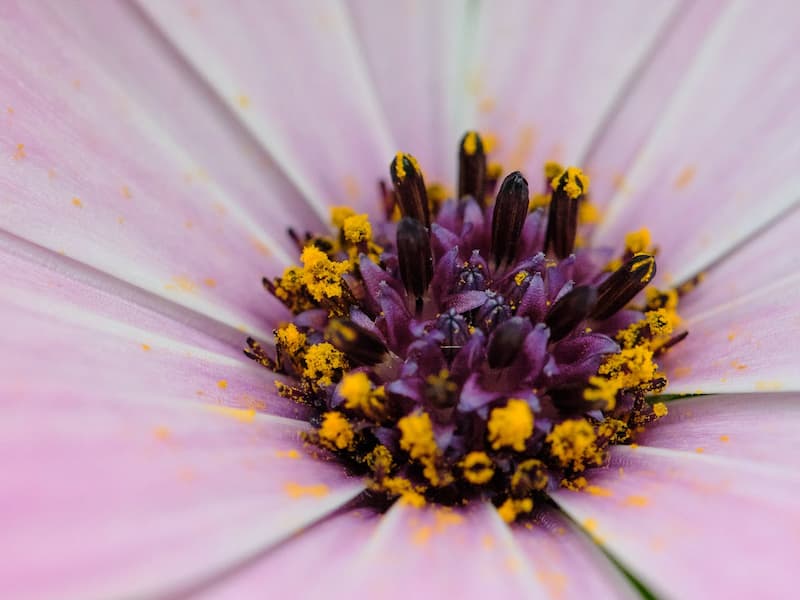
As bees forage, some pollen grains escape. If by chance they land on the stigma (the tip of the female reproductive organ) of another flower of the same species, a cascade of enzymatic reactions begins. The pollen grain swells and releases a pollen tube through the apertures. It moves down the pistil, its male gametes reach the ovules at the heart of the flower, and thereby ensure the plant's reproduction. This final step is made possible solely because pollen grains are rich in enzymes, minerals, and vitamins!
All these rich components (proteins, essential amino acids, fibers, lipids, minerals, vitamins) explain why pollen grains are heavy and sticky when they are designed to be attractive to insects, unlike wind-borne pollens which are light and of no nutritional value. Moreover, it is these anemophilous pollens that easily penetrate the respiratory tract and cause allergic reactions such as rhinitis or hay fever on irritated mucous membranes.
...and Enriched by Bees
While foraging flowers, bees enrich this natural matrix from the plant world by inoculating it with ferments from their digestive tract raised on nectar. Before setting off to harvest pollen, the bee swallows drops of nectar which she stores in her honey stomach. Throughout the harvest, she regurgitates it to stick the pollen grains together and form the pellets that she places in the baskets located on her hind legs. The bee then performs the exceptional work of a biochemist by enriching the pollen with about ten strains of bifidobacteria and lactobacillus. In humans, these are valuable allies for intestinal balance.
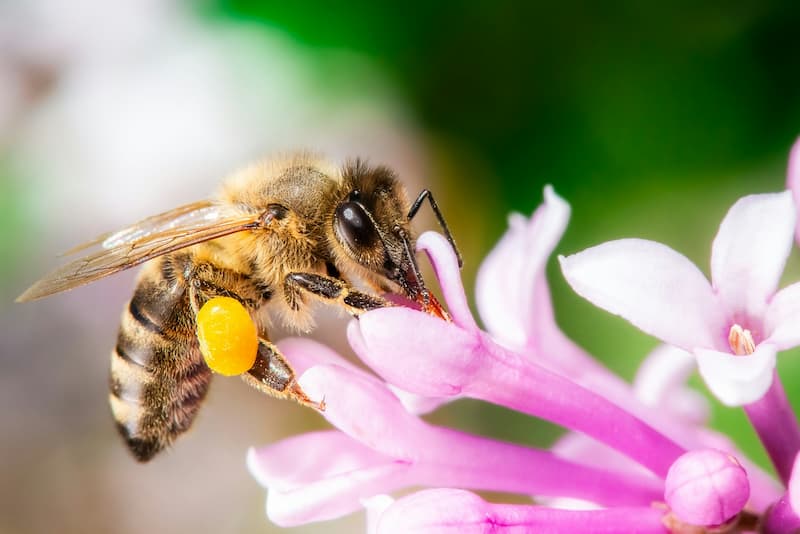
Back in the hive, the bees pass through pollen traps or grids. With each pass, they drop a few pollen pellets into a drawer. Regularly harvested by the beekeeper, the pollen is immediately frozen. It is then analyzed, checked, and ventilated to eliminate residues from the hive. Finally, bee pollen is packaged at our production sitein Saint-Hilaire-de-Lusignan, in the Lot-et-Garonne region.
Why freeze bee pollen?
Pollen is traditionally dried using warm ventilation after harvesting and marketed in jars. This technique makes it possible to obtain a product virtually devoid of water, which keeps for a long time at room temperature. The major disadvantage of this process lies in the loss of a large part of the pollen's nutritional quality. However, as you have understood, the complexity of pollen must absolutely be preserved because it is what makes it a superfood that nourishes and balances the body.
Scientific studies led by Patrice Percie du Sert in collaboration with several research institutes have made it possible to evaluate the impact of different preservation methods (fresh frozen, dried at 5°C, dried at 40°C, freeze-dried) and the effect of aging on the evolution of the lactic flora of pollens harvested by bees. These studies have demonstrated that freezing in its fresh state is what best preserves the lactic ferments of pollens. All micronutrients sensitive to heat and desiccation are thus safeguarded.
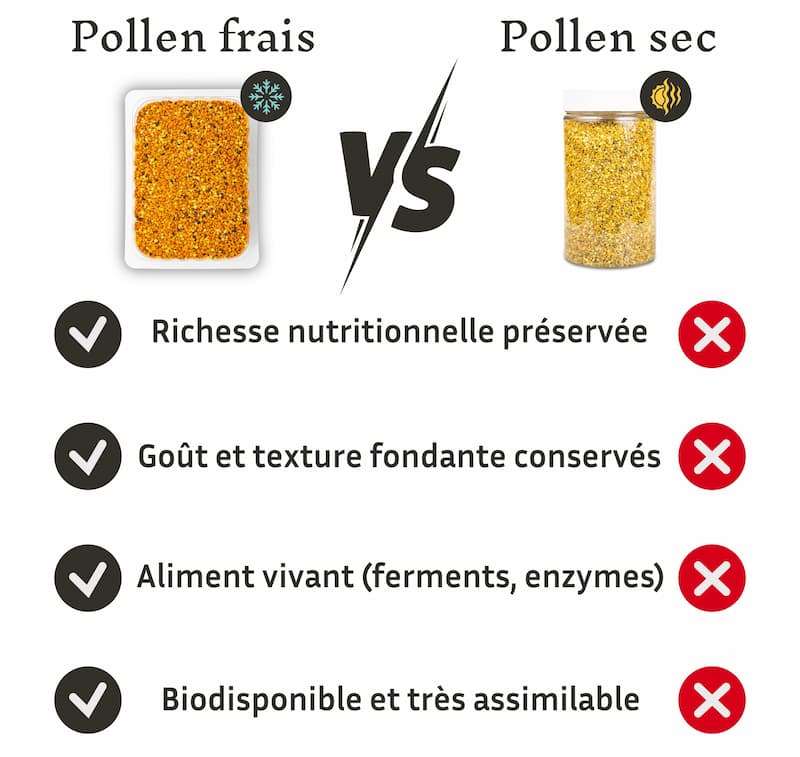
Pollenergie packages its pollens using a patented process that combines a controlled atmosphere with freezing, allowing them to travel for 7 days at room temperature without undergoing any alteration. Without these precautions and protections, pollen—which is unstable by nature—would become unfit for consumption.
Nutritional Characteristics of Fresh Pollen
The specifications applied to our partner beekeepers guarantee the floral origin of our pollens as well as the absence of any hive residues. They are harvested in wild areas or with Organic certification, at times of the year corresponding to the specific blooms of the botanical species concerned.
It is well known that pollens harvested by bees have extremely beneficial characteristics for human health. Without detailing the full nutritional analysis of each pollen, we can cite their main composition:
- 15 to 22% plant proteins, which are levels higher than eggs and even equivalent to certain meats
- 4 to 6% lipids, represented by Polyunsaturated Fatty Acids up to 50%
- 50 to 60% carbohydrates
- 10 to 14% fibers
- a very significant amount of bee-specific lactic ferments of the lactobacillus bifidobacterium type
- a very high richness in vitamins
- like all plants, fresh pollens are very rich in minerals and trace elements (calcium, iron, magnesium, phosphorus) and present a very favorable potassium/sodium ratio
- a very high richness in antioxidant micro-constituents (carotenoids and polyphenols), up to 10 times higher than those of fruits and vegetables
- more than 80 enzymes have been identified in unseasoned, fresh pollen
Benefits of Fresh Pollen in General
When preserved in its fresh form, pollen is a highly complete food. Combined with a balanced diet, regular consumption of fresh frozen pollen helps support the proper functioning of numerous organic processes. While there are significant nutritional differences between pollens of different floral origins, they all share common properties.
Energy Boost
Thanks to its concentration of plant proteins, fibers, vitamins, minerals, and trace elements, fresh bee pollen helps reduce fatigue, boost the body, and improve its resilience. Raw pollens have a protein content ranging from 15 to 35% depending on their botanical origin. This content is higher than all plant sources and even some animal sources such as eggs. These plant proteins are of excellent quality, featuring highly beneficial levels of Essential Amino Acids (EAAs): stimulators of protein synthesis, modulators of inflammatory states, and improvers of the intestinal mucosa's condition...
Improves the Microbiota
Combined with fibers, the lactic ferments in fresh frozen pollen help restore a high-quality intestinal flora, allowing for better absorption of macro and micronutrients from our diet. Pollen is a food rich in fiber, mostly insoluble, representing nearly 50% of the Recommended Daily Allowance (RDA). It is widely recognized that dietary fibers contribute to improving the functional state of the intestinal system. Furthermore, pollen - only when it is fresh - contains a large amount of bee-specific lactic ferments that contribute to improving the intestinal flora (probiotic effect).
Strengthens Immunity
Our intestinal mucosa concentrates around 60 to 70% of the immune system, ready to face threats from pathogens carried by our food. Consequently, improving the digestive system leads to an enhancement of natural defenses. By rebalancing and strengthening the intestinal flora, fresh frozen pollen contributes to the normal functioning of the immune system. Fresh pollens have an excellent potassium/sodium ratio (between 14 and 18). This aspect gives them a strong alkalizing potential. Bee pollens also contain phytosterols, which are natural compounds found in plants.
Antioxidant Intake
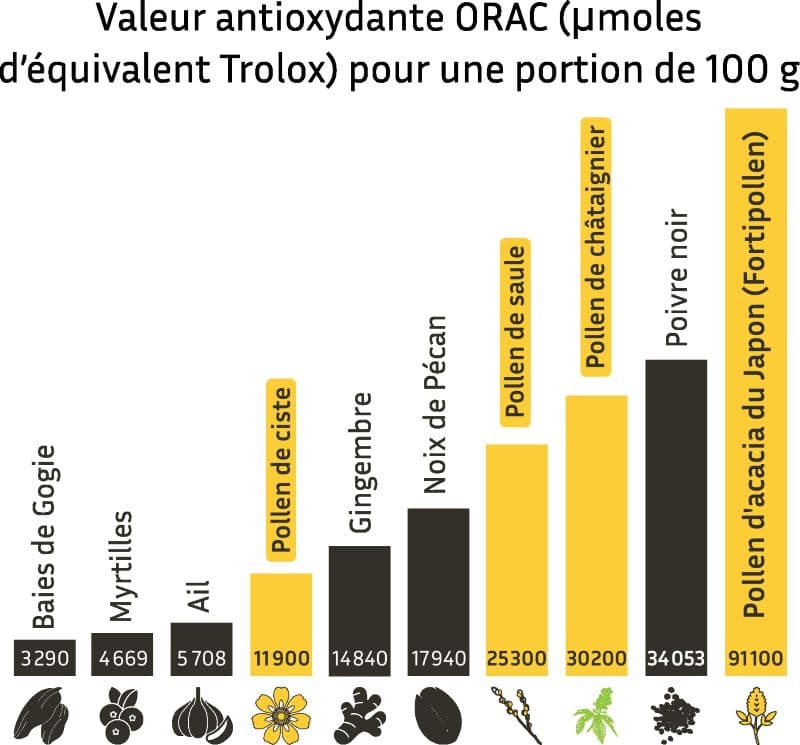
One of the theories of cellular aging is the excess of free radicals in the body, which alter macroelements such as proteins, lipids, or DNA, thereby contributing to their dysregulation. With age, radical production increases, while antioxidant defenses decrease. Pollens, especially when kept fresh, are rich in vitamins and other antioxidant molecules, minerals, and trace elements (vitamins C and E, polyphenols, and carotenoids). They achieve the highest antioxidant capacity values in the plant kingdom. For instance, chestnut pollen has an antioxidant power 10 times higher than grapes!
Benefits of Fresh Monofloral Pollens
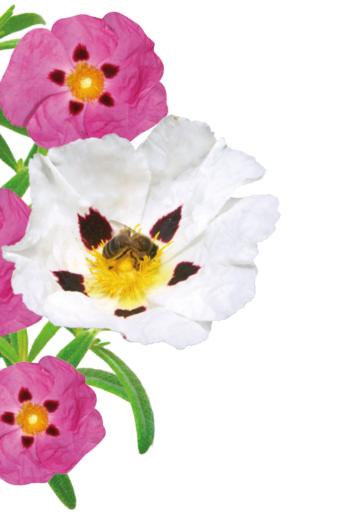
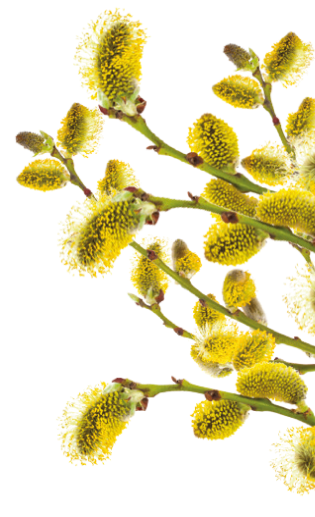
Our range of fresh frozen pollens is structured around eight exceptional floral origins: cistus, Japanese pagoda tree, hawthorn, heather, cherry, chestnut, willow, and fruit willow. At Pollenergie, we favor this specific approach because, beyond a shared nutritional foundation, each flower infuses unique properties essential for responding precisely to your needs.
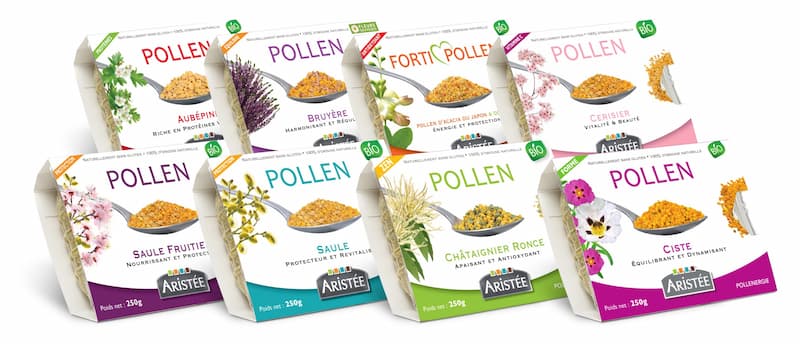
As pioneers in apicultural research, our extensive studies on the nutritional composition of pollens have led us to focus on a monofloral approach. This specialization allows us to target precise physiological needs, of which here are 3 examples:
- Cistus pollen: exceptionally rich in lactic ferments (notably Lactobacillus kunkeei), it is the preferred ally of the intestinal flora and the immune system.
- Chestnut pollen: its natural concentration of vitamin B6 and tryptophan promotes serotonin synthesis, offering valuable support for emotional balance and stress management.
- Heather pollen: a source of rutin, a flavonoid that promotes the flexibility of blood vessels, it contributes to capillary tone for optimized microcirculation.
The virtues of the plant must not be confused with those of its pollen! Pollen possesses its own nutritional identity. For instance, although the willow tree is the origin of aspirin, its pollen does not thin the blood and can be safely consumed by patients on anticoagulant treatment. Similarly, the blood-pressure-lowering effect of hawthorn is absent in its pollen.
How to store fresh bee pollen?
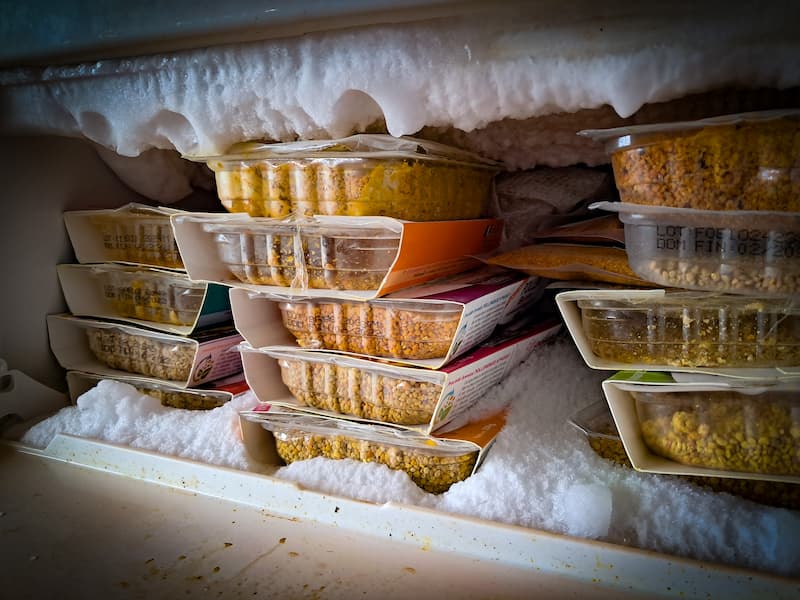
Upon receipt of the product, the pollen tray must be placed directly in the freezer. We recommend taking one teaspoon to one tablespoon per day. The pollen must be kept at sub-zero temperatures throughout the entire course. This hive product contains very little water! Even when frozen, its pellets separate easily and retain their melting texture. It is also possible to scoop out 3 large tablespoons to place in an unsealed bowl in the refrigerator. This portion will cover daily consumption for the next three days (based on one tablespoon every morning). This procedure ensures that all the nutritional properties of the product are preserved. Thanks to our innovative preservation process and as long as it has not been opened, a pollen tray can be frozen and thawed several times without any risk of deteriorating this treasure of the hive.
Should bee pollen be thawed before consumption?
It is not necessary to thaw the pollen before enjoying it. Since it contains less than 20% water, it does not harden or form ice crystals; the cold simply stabilizes its nutrients without altering its structure.
You can therefore consume it directly out of the freezer. If you prefer, you can keep a small reserve (about 3 tablespoons) in the refrigerator in a bowl covered with a cloth. However, be sure to consume it within 4 days, as beyond that, the precious lactic ferments begin to degrade.
How to Use Fresh Pollen
Contrary to popular belief, pollen is not best consumed on an empty stomach. We recommend eating it during a light meal. This facilitates the assimilation of its "totum"—this unique combination of nutrients, probiotics, and prebiotics that work in synergy. Taken alone on an empty stomach, the prebiotic fibers can cause bloating.
How much pollen should you take?
Pollen is a highly nutrient-dense superfood. For daily use, one tablespoon is generally enough for an adult. However, this dosage can vary depending on individual profiles:
- Adults: 1 tablespoon (12 to 15 g) per day. This dose can be doubled for athletes or during an intensive 3-week course.
- Vegetarians & food lovers: up to 4 tablespoons per day without any risk of overdose, as pollen is a natural and non-toxic food.
- Children (up to 12 years old): 1 teaspoon per day. If they ask for more, the child's appetite remains the best indicator of their needs.
- Sensitive intestines: start with 1 teaspoon per day for a week to avoid the transit-accelerating effect caused by the fibers, then increase gradually.
Instinct is a good guide, and wanting to eat more simply means that we need it.
Can you take pollen continuously?
We often forget it, but pollen harvested by bees is a food. There is no risk of toxicity in taking it daily—quite the contrary! Consuming pollen is even recommended for people who wish to naturally support chronic health issues or prevent disorders related to the aging of the body. However, its nutritional richness can sometimes saturate the system; a temporary break from the course is then recommended before resuming under better conditions.
Can you consume pollen when the expiration date has passed?
Even if the expiration date has passed, do not throw away your pollen! It can be safely consumed if it has been kept in the freezer without interruption. Even if we are talking about a whole year! Also, make sure not to leave your tray open to the open air for more than 72 hours. However, if you have any doubts, give the pollen to your plants: mixed with potting soil or compost, it makes an excellent fertilizer!
BBD vs Exp. Date: The date indicated on our pollens and other products is a Best Before Date (BBD). It is indicative: past this deadline, the product poses no danger to health, but it may lose flavor or nutritional effectiveness.
Mistakes to Avoid

Consuming Pollen on an Empty Stomach
To best enjoy their benefits without any discomfort, it is important to consume Aristée pollens preferably during breakfast (or during a light meal / snack) along with fresh fruit or fruit compote. Indeed, their richness in enzymes and lacto-ferments can cause bloating or flatulence... and they will also be less effectively absorbed! Discover our recipes

Mixing Pollen with Hot Food
To preserve the precious lactic ferments of fresh pollen, never mix it directly with hot food or beverages. Thermal immersion destroys its enzymes. However, you can consume a hot drink alongside it: the heat dissipates quickly in the stomach, protecting its nutritional qualities. The key: do not mix them before ingestion.

Switching pollens from one day to the next
To fully benefit from the advantages of a specific floral origin, it is important to follow a continuous course for at least 3 weeks. This allows the body to better absorb its nutrients for superior results on vitality, protection, and well-being. You can then choose a different floral origin for the following 3 weeks.