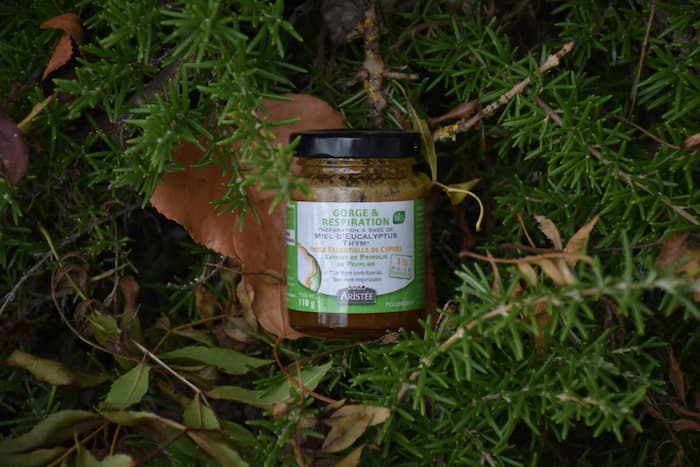
Certified organic propolis tincture, ideal for boosting immunity and protecting... [Read...]
Intensive propolis lozenges (Organic)
Organic propolis lozenges to relieve throat discomfort, irritation, and hoarseness. Pack of 25 Biopastilles.
Read more- Free delivery from €65 in France
- In stock (3550)
-
At home on monday 5 october 2026info
- Help and advises 05 53 68 11 11
- 20 years old french manufacturer
Naturally soothe a sore throat
Our organic propolis lozenges are ideal for soothing a sore throat and freshening breath. They work as soon as you feel the first signs of discomfort, tickling, or irritation in your throat. The gentle release of their natural active ingredients enhances their effectiveness. Absorption through the mouth’s mucous membranes bypasses the digestive tract, thereby preserving all their purifying and refreshing benefits.
100% natural, these organic lozenges are concentrated in propolis, which has cleansing properties. It coats the mucous membranes with an active, antibacterial protective layer to quickly soothe irritation.
Our intense propolis Biopastilles are cold-pressed with essential oils, with no added sugar, no artificial ingredients, and no cooking.
Contains 30 mg of propolis per lozenge. A maximum amount of fresh propolis to protect, soothe, and relieve the throat of discomfort and a scratchy sensation.
Oral Hygiene
The Organic Lozenges combine the cleansing properties of fresh poplar propolis with the fresh, fruity flavors of essential oils for fresh breath.
The Organic Lozenges also provide protection against cavities, especially when it is impossible to brush your teeth after a meal.
Acacia gum*, dry propolis extract*, bulking agent: magnesium carbonate, cocoa butter*. Contains 30 mg of propolis per Biopastille. No artificial colors or preservatives. 100% natural.
Store at room temperature.
Packaging: Bag of 25 lozenges. 15 g.
*From organic farming.
Quality criteria of our propolis
1. The harvesting method
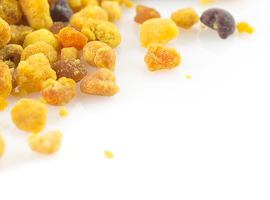
In Europe, there are two practices: scraped propolis and mesh propolis. Beekeepers collect propolis either by scraping the hive frames or by the so-called "mesh" method. The latter consists of placing meshes above the hive frames in the spring and removing them in September. This method yields fresh propolis, rich in active ingredients, non-oxidized, and containing very little waste.
Scraped propolis comes from scraping the frames and contains hive treatment products, wax, and other toxic substances. Unfortunately, it is marketed by various brands. Even in an organic hive, there are many pollutants in this propolis, and it is even worse if the hive is old. This propolis is only fit to be thrown away. Is this stated on the packaging? No, of course not. Those who use scraped propolis do not brag about it!
All our propolis products are systematically analyzed to guarantee our customers a product free of heavy metals, including those that do not have organic certification.
2. Botanical origin
The botanical origin is what makes propolis unique. There are several types of propolis depending on the plants present in the hive's geographical area, the availability of plants during the season, and the bee species. This is why we speak of green propolis when it comes from Baccharis, red propolis for Dalbergia, and brown or black propolis when it comes from poplar. Each botanical origin produces specific organic compounds involved in its defense mechanism. Therefore, propolis has a unique chemical composition, characterized by a variable polyphenol profile.
3. Guaranteed polyphenols
On the label, check that the product has a standardized active ingredient content (polyphenols). Propolis containing 25% or 30% polyphenols is magical! Unfortunately, the law does not require this to be stated on the label. Also, carefully check for a guarantee of the absence of heavy metals and pesticides. Beware of brands that do not state this!
ENT Sphere Pathologies
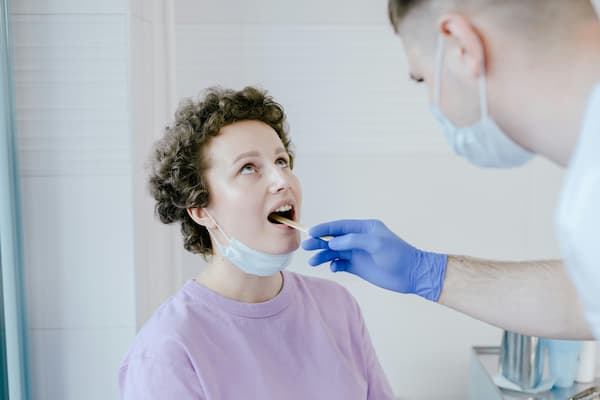
ENT (Ear, Nose, and Throat) pathologies infect your nose, throat, ears, and sinuses. In France, these infections are the leading causes of consultations with pediatricians and general practitioners. A study conducted in France in 2006 and 2007 revealed that the average number of consultations for these ENT pathologies was 18.6 million per year!
From an economic standpoint, these pathologies have a major direct impact, with an estimated cost of 1 billion euros, as well as an indirect impact due to absenteeism and sick leave. These ENT infections are therefore very common and most often benign, with a spontaneous recovery probability of over 80%.
In respiratory function, the nose is an essential element. It is the gateway for microbes circulating in the ambient air. It is therefore important to wash the nose regularly to clear out mucus. Nasal washing also helps eliminate bacteria and viruses that can be responsible for nasal infections.
Viruses to Blame
The origin of ENT infections is most often viral. This is the case for rhinopharyngitis, as well as 70% of tonsillitis cases and 40% of ear infections. But remember that famous public health campaign that told us: "antibiotics are not automatic!".

And yes! Antibiotics have very limited effectiveness on viral infections, and conversely, their repeated use is known to drive the emergence of resistance in microbial germs. A French survey revealed that 33% of doctors felt they prescribed antibiotics at the request of parents. One of the consequences of this was that in 2006, France had one of the highest rates of pneumococcal resistance to penicillin in Europe (36%). It is therefore important to realize that beyond these pathologies, their cost must not be worsened by inappropriate parental and medical habits.
Propolis, an Alternative to Antibiotics
The main viruses responsible for these conditions belong to the rhinovirus, coronavirus, adenovirus, and influenza virus families. And ENT infections of bacterial origin are mainly caused by Streptococci, Haemophilus influenzae, Staphylococcus aureus, and Pseudomonas aeruginosa.
Among hive products, propolis is recognized as a true "natural antiseptic". It is a concentrate of protective substances containing mostly polyphenols, including flavonoids, phenolic acids, aromatic acid esters, and essential oils. This combination of purifying substances naturally contributes to the body's protection and resistance. This effect is enhanced if propolis is taken before infection.
The flavonoids in propolis have a direct action on the virus (at the level of host cell penetration or replication) and an indirect action by strengthening our immune system. Regarding infections of bacterial origin, there are many more studies demonstrating the effectiveness of propolis as an antimicrobial agent. Most bacteria involved in these conditions are sensitive to propolis, even antibiotic-resistant bacterial strains.
Action of Propolis on the Flu or Colds
In the case of the flu or a cold, the polyphenols in propolis will exert a soothing antiseptic action, particularly when taken in liquid form, by creating a protective veil over the respiratory tract. The molecules in propolis will also trigger several metabolic pathways that allow the body to better defend itself by supporting our immunity. Propolis thus helps to reduce the intensity and duration of the flu episode, as with many other infections. It is worth describing step-by-step the usefulness of propolis for both prevention and support:
1. Propolis exerts a prophylactic effect
This point is crucial! When given for prevention, propolis enables the body to better defend itself once the infection occurs. Its protective effect will be amplified. It prepares the body by exerting an immunostimulant effect. This effect is dose-dependent, and it is important to absorb a sufficient quantity of polyphenols to ensure it.
2. Propolis has antiviral capabilities
Propolis thwarts the penetration of the virus. Certain specific flavonoids found in brown poplar propolis have an anti-neuraminidase action (observed in vitro) and hinder the spread of virions, thereby preventing the infestation of our healthy cells.
3. Propolis acts on the innate and adaptive immune response
Propolis stimulates the phagocytic activity of macrophages, our first line of defense. The destruction of infected cells by Natural Killer cells is also boosted. If this bodily response is not enough, adaptive immunity steps in. And here again, propolis plays the role of a conductor by stimulating B lymphocytes for increased antibody production.
We can also be reassured about the action of poplar propolis, which is primarily interesting for its adaptogenic qualities on immunity. Namely, it increases the body's resistance against stressors (viruses, bacteria). Through its antiviral activity, propolis will help regulate excessive immune system reactions and generate a harmonization of immune responses in reaction to infection.
Other Solutions from the Hive
Propolis is not the only thing that can be useful in ENT infections. Certain honeys also contain a high amount of flavonoids. They can also contain volatile molecules with recognized antiseptic properties, as well as specific beneficial actions (such as bronchodilator activity in eucalyptus honey, for example).

Honey and propolis are the most recommended for ENT prevention, although pollen (provided it is fresh) is not without merit in this area. For greater effectiveness, it is best to combine a direct "contact" action using sprays, mother tinctures, or lozenges, with a systemic action that strengthens the immune system using propolis capsules. Hive products are therefore an appropriate therapy for viral or bacterial ENT infections, whether used alone or in combination with antibiotics. Numerous studies have shown that the concomitant intake of propolis increases the efficacy of many antibiotics.
Our Aromiel and Propolis Recipe
We recommend preparing your mixture for the day (the equivalent of 4 to 6 teaspoons to be taken throughout the day). In a bowl, pour the equivalent of 2 generous tablespoons of honey, then add the contents of one single-dose of extra-sttrenght poplar propolis. Mix well, then add the essential oils:
- 3 drops of tea tree essential oil, Melaleuca alternifolia
- 2 drops of radiated eucalyptus essential oil, Eucalyptus radiata
- 3 drops of ravintsara essential oil, Cinnamomum camphora
- 2 drops of peppermint essential oil, Mentha piperita
-
Product TypePropolis
-
Type of propolisBrown propolis
-
My needsENT sphere
Pregnant women and breastfeeding
Children and adolescents -
LabelCertifié bio
-
FormatLozenges
Français
English