Why Are We Stressed?
However, in our current civilization, we are not constantly in "life-threatening" danger; yet, numerous stressful elements surround us. These elements most often stem from our daily activities and lifestyle: work, raising children, pressure to meet goals, financial difficulties, difficult marital relationships…
All of these situations do not necessarily cause major stress, but rather a moderate, cumulative, and continuous stress that ultimately disrupts the body's natural balance. When this stress manifests continuously, it can lead to a wide variety of more or less interconnected disorders, such as on a physiological level: accelerated aging, nutritional deficiencies, immune deficiencies, psychiatric problems, psychosomatic illnesses, worsening of medical conditions, and on a social level: disruption of personal and professional life with sleep, learning, and concentration disorders, as well as a reduced capacity to adapt, drawing the individual into a downward spiral.
From a physiological point of view, the organism can be seen as a system in balance, known as "homeostasis." Every stressor that disrupts this balance forces the organism to implement adaptations to restore equilibrium and ensure its survival. Our cerebral, cognitive, and emotional balance is regulated by the combined action of neurotransmitters (including acetylcholine, serotonin, melatonin, dopamine, and adrenaline). These are involved in regulating mood, sociability, thermogenesis (serotonin), sleep regulation (melatonin), motivation, self-esteem, reward, pleasure or libido (dopamine), and the regulation of autonomic neuromotor activity (acetylcholine).
Any element whatsoever (food substrate deficiency, exogenous stressor, illness, etc.) that disrupts this balance between neurotransmitters will lead to harmful consequences for the body. The total accumulated daily stress results in an elevation of cortisol levels in the blood. When present in too high a quantity over long periods, this molecule will lead to a slowing of bone formation, an inhibition of inflammatory responses, a weakening of the immune system, and an inhibition of neurotransmitter transmission within the central nervous system. Thus, we know for example that depressed individuals have higher blood cortisol levels than normal and, at the same time, lower serotonin levels than normal. It is therefore essential to help our body as much as possible to regulate its neurotransmitter levels.
The Positive Power of Beehive Products
To look on the bright side of life, it is essential to give the body the right fuels that will allow it to feel alert, both physically and mentally. Favoring high-quality foods is fundamental for morale. Stress, frustration, depression, anxiety—now is the time for a good course of superfoods like fresh bee pollens combined with royal jelly to put an end to gray mornings!
The transmission of nervous information between two neurons occurs through neurotransmitters. They are synthesized by the presynaptic neuron and stored in vesicles. These vesicles release their contents into the synaptic cleft. These neurotransmitters then bind to specific receptors on the postsynaptic neuron, thereby ensuring the transfer of information for a few milliseconds. After carrying out their action, the neurotransmitters released from their receptors are either recaptured by the presynaptic membrane or degraded in the synaptic cleft by specific enzymes: Monoamine Oxidases (MAO).

Depressive states are known to be characterized by too low a concentration of neurotransmitters in the synaptic cleft. Current medicinal solutions for these disorders involve using molecules that inhibit these enzymes, thereby allowing these neurotransmitters a longer window of action. One study showed that honey, fresh chestnut bee pollen, and propolis exerted an inhibitory action on these MAOs. Another in vivo study demonstrated that an oily extract of green propolis from Baccharis Dracunculifolia exerted an "antidepressant and anxiolytic-like" action on the behavior of animals subjected to acute stress.
Why are pollens beneficial?
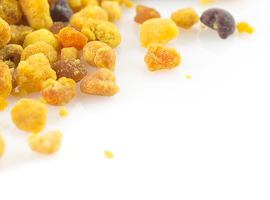
Pollens are rich in plant proteins and contain all essential amino acids. Neurotransmitters are synthesized from elements contained in these amino acids. They cannot be synthesized by the body and must therefore be provided through diet. The quantitative level of these neurotransmitters is directly correlated with specific psychological disorders such as depression, irritability, and memory loss.
- Tryptophan, an amino acid that cannot be synthesized by the body, is the precursor to serotonin. Insufficient levels can be responsible for nervousness, aggressiveness, and anger. Pollens richest in tryptophan: chestnut and hawthorn.
- Phenylalanine is then transformed into tyrosine (a precursor to dopamine and noradrenaline), two neurotransmitters that stimulate the brain. Pollens richest in phenylalanine: chestnut, hawthorn, willow, and fruit willow.
- Methionine is essential for the proper functioning of all other neurotransmitters. Pollens richest in methionine: hawthorn, Nutripollen, Effipollen Digestive Harmony, and heather.

Pollens are rich in B-group vitamins (as is royal jelly). They play a major role in energy production and the health of the nervous system. Beyond physical issues, their deficiency inevitably leads to many nervous and behavioral dysfunctions. They are often degraded by food preservation and cooking conditions, which makes their presence in industrial food highly unpredictable!
| B Vitamins |
Role in nervous balance |
Richest pollens |
| B1 |
Effect on depression and fatigue |
willow / fruit willow / hawthorn |
| B3 |
Effect on the transmission of nerve impulses and a significant effect on mood |
cherry / willow / fruit willow / kidoupollen fortifying |
| B5 |
Helps the proper functioning of the nervous system. Anti-stress action |
willow / fruit willow / kidoupollen fortifying / chestnut |
| B6 |
Anti-stress and anti-depressant action |
hawthorn / chestnut |
| B9 |
Promotes emotional balance |
cherry / hawthorn |
Hawthorn pollen, rich in vitamin B6, has an anti-stress and anti-depressant action that is essential for the formation of thoughts, emotions, and coordination. It is also rich in tryptophan, the precursor to serotonin, also known as the good mood hormone.
Chestnut pollen is a source of potassium and rich in vitamins B2 and B3, which contribute to the normal functioning of the nervous system. Stress stimulates energy metabolism and therefore generates an excess requirement for vitamins B2 and B3 to meet this stimulation. A deficiency in these vitamins can lead to disruptions in the normal functioning of the nervous system. This pollen is also rich in vitamin B6, which contributes to normal psychological functions, and provides the body with tryptophan, an amino acid precursor to serotonin involved in regulating mood and anxiety.
Why take royal jelly in case of stress?
Royal jelly is also rich in B-group vitamins and contains acetylcholine, which exerts a very favorable action on the sympathetic and parasympathetic nervous systems. It will boost the transmission of nervous information, which is responsible for concentration and memory! It is also one of the richest foods in vitamin B5, pantothenic acid, which helps the proper functioning of the nervous system. Royal jelly also helps to regain a good energy level when exhausted, to relax, and to sleep better when stressed. As an adaptogen, it helps the body adapt to various situations likely to disrupt its functioning.
 Français
 English