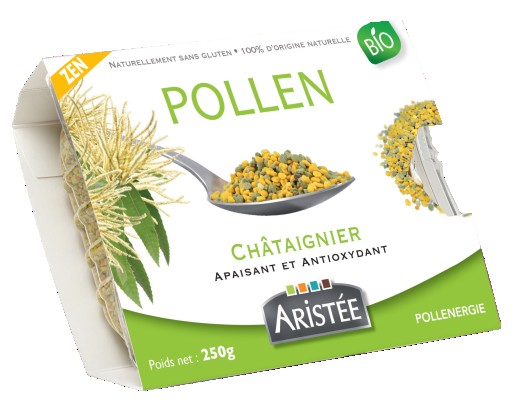
Fresh willow bee pollen (Organic)

Certified organic
Price: €27.90

card_membership By buying this product you can collect up to 27 loyalty points. Your cart will total 27 points that can be converted into a voucher of €1.35.

Directions for use

Selected, collected, and processed by bees, the synergy of polyphenols and carotenoids in this organic pollen helps protect against the harmful effects of oxidative stress and age-related changes in the body. 250-g container; store in the freezer upon receipt.

Read more
Practical informations :
  • Free delivery from €65 in France
  • In stock (183)
  • At home on monday 5 october 2026
    info
  • Help and advises 05 53 68 11 11
  • 20 years old french manufacturer
Description
Description

Balls for protecting the body

Taken as a regular course (3 to 4 times a year) or throughout the year, a tablespoon of fresh-frozen organic willow pollen helps protect against the effects of aging. It is perfectly suited for people over 50 to support the body.


Properties specific to willow bee pollen

Protecting the body after 50

Organic bee-collected willow pollen is rich in vitamin B2, vitamin C, vitamin E, and zinc, which contribute to protecting cells against oxidative stress. It is an excellent ally for protecting the body after 50.

It is also rich in vitamins B3 and B9, which contribute to reducing fatigue. Thanks to this exceptional nutritional density, it is particularly well-suited for people seeking vitality.

Nutritional deficiencies

Due to its high nutritional value, both in terms of micronutrients (vitamins and minerals) and macronutrients (plant proteins), organic willow pollen is perfectly suited for seniors.

Ingredients
Ingredients

Organic willow pollen (Crataegus sp.), minority of other pollens from the surrounding flora. No colorants or preservatives. Hawthorn pollen grains are harvested between April and May. Predominantly sweet flavor with hints of bitterness. Melting to silky texture. Light yellow color.

Packaging

250 g tray under protective atmosphere. Origin: European Union. Store in the freezer between -15° and -18° C upon receipt.

Fresh bee pollen is a raw, living, highly complete and complex food that degrades very quickly in the air and at room temperature. Pollenergie packages its pollens using a patented process, combining a controlled atmosphere with freezing, allowing them to travel for 7 days at room temperature without any alteration. Once delivered, the pollen can be safely refrozen to guarantee its full nutritional potential.

Discover our patented process

Can bee pollen be consumed after the expiration date?

Even if the deadline has passed, don't throw away your pollen! It can be safely consumed if it has been kept in the freezer without interruption—even for a whole year! Also, make sure not to leave your tray open to the air for more than 72 hours. If you have any doubts, give the pollen to your plants: mixed with potting soil or compost, it makes an excellent fertilizer!

BBD vs. Use-By Date: The date indicated on our pollens and other products is a Best-Before Date (BBD). It is indicative: after this period, the product presents no health hazard, but may lose flavor or nutritional effectiveness.

Directions for use
Directions for use

Storing fresh bee pollen

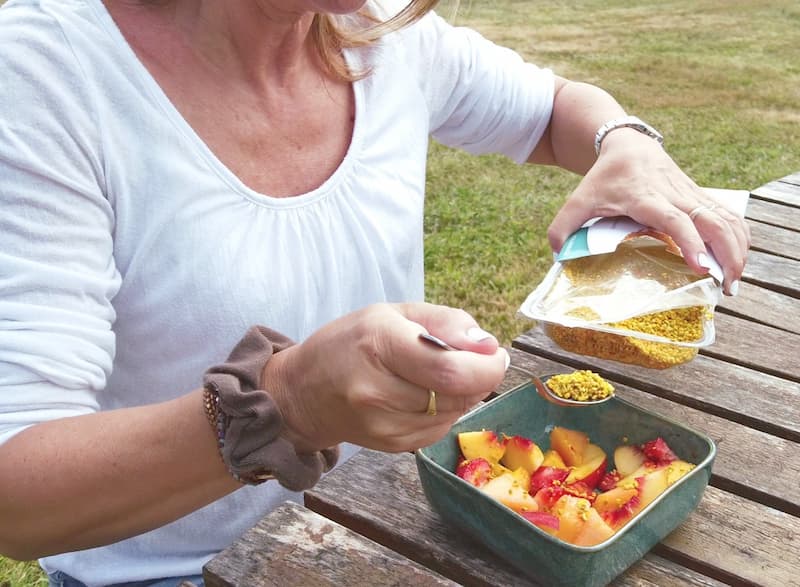
As soon as you receive it, place your pollen tray in the freezer to preserve all its nutritional qualities. It is not necessary to defrost the pollen before tasting it. Thanks to its low water content, the pollen remains melt-in-the-mouth and easy to scoop, even when frozen. You can therefore consume it directly out of the freezer.

How to take bee pollen?

Contrary to popular belief, pollen is not more effective on an empty stomach. The ideal way is to consume it during a light meal to help your body better absorb its entire cocktail of nutrients and probiotics. For daily use, one tablespoon is generally sufficient. However, this dosage may vary according to different profiles:

  • Adults: 1 tablespoon (12 to 15 g) per day. This dose can be doubled for athletes or during an intensive 3-week course.
  • Vegetarians & food lovers: up to 4 tablespoons per day without risk of overdose, as pollen is a natural and non-toxic food.
  • Children (up to 12 years old): 1 teaspoon per day. If they ask for more, the child's appetite remains the best indicator of their needs.
  • Sensitive intestines: start with 1 teaspoon per day for a week to avoid the transit-accelerating effect due to fiber, then increase gradually.

Instinct is a good advisor, and wanting to eat more simply means that we need it.

Can bee pollen be taken continuously?

It is often forgotten, but the pollen collected by bees is a food. There is no risk of toxicity in taking it daily—quite the contrary! Pollen consumption is even recommended for people who wish to naturally support chronic health problems or prevent disorders linked to the body's aging. However, its nutritional richness can sometimes saturate the system; a temporary interruption of the course is then recommended to better resume afterwards.

Errors to avoid

Taking pollen on an empty stomach

Consuming bee pollen on an empty stomach

To better enjoy their benefits without discomfort, it is important to consume Aristée pollens preferably during breakfast (or during a light meal / snack) with fresh fruit or compote. Their richness in enzymes and lacto-ferments can indeed cause bloating, flatulence... And they will also be less well assimilated!

Mixing pollen with hot food

Mixing bee pollen with hot food

To preserve the precious lacto-ferments of fresh pollen, never mix it directly with hot food or drinks. Thermal immersion destroys its enzymes. You can, however, consume a hot drink alongside it: the heat dissipates quickly in the stomach, protecting its nutritional qualities. The important thing: do not mix them before ingestion.

Switching bee pollens from one day to the next

To make the most of the benefits of a floral origin, it is important to follow a consistent course for at least 3 weeks. This allows the body to better absorb its richness for better results on vitality, protection, and well-being. You can then choose another floral origin for the following 3 weeks.

Physical and mental fatigue

When Stress Takes Center Stage

The transition out of winter is a period highly conducive to seasonal blues. In winter, we see less light. Yet, light is a source of energy for every one of us. When our body struggles to cope, it becomes deeply fatigued, sometimes even showing symptoms of depression. Whatever the season, fatigue in its various forms is a warning sent by the body demanding a break!

Normal fatigue is physiological and muscular. It generally occurs after physical exertion, prolonged stress, or a lack of sleep. It most often disappears after much-needed rest.

Organic fatigue, also known as asthenia, most frequently manifests alongside an underlying pathology such as a nutrient deficiency, an infection, or a progressive disease. It can also be linked to irregular work hours that interfere with biological rhythms.

Nervous fatigue is characterized by the fact that it no longer yields to rest alone. It is accompanied by insomnia or, conversely, hypersomnia, and is most prominent upon waking. It signals an imbalance in the central nervous system following excessive demand. This can lead to the onset of: depression, fibromyalgia, chronic fatigue syndrome, a drop in libido and overall energy, and an inability to put forth physical and mental effort.

La fatigue sous toutes ses formes est un avertissement envoyé par l’organisme qui réclame une pause !

Statistical observations of fatigue reveal that overall, 39% of fatigue cases have an organic cause, 41% a psychological cause, 10% a mixed cause, and 10% undetermined causes. The imaginary invalid does not exist. Fatigue in all its forms is a warning sent by the body demanding a break!

In all cases, it is important to remember that fatigue leads to an accumulation of lactic acid and other metabolic waste in the muscles and the entire body. Permanent fatigue undoubtedly stems from this build-up of toxins. Before thinking about toning the body, it is preferable to cleanse it.

Pampering Your Liver with Chestnut Pollen

Thanks to its antioxidant potential, chestnut pollen has hepatoprotective effects, meaning it helps clear the liver of fat. It is rich in fiber (>13 g/100 g), including insoluble fiber which, by absorbing water, increases stool volume, thus helping to regulate and rebalance intestinal function. Since the intestine is one of the main organs contributing to the elimination of toxins from the body, it is therefore important for it to be in a good physiological state.

Pollen frais de châtaignier

Chestnut pollen also contains selenium, which actively participates in the detoxification of xenobiotics—low molecular weight molecules that are foreign to the body (medications, water pollutants, food additives, certain natural food compounds, etc.). Selenium is part of the structure of several antioxidant enzymes: glutathione peroxidases and thioredoxin reductase. These enzymes help neutralize the excess of free radicals present in the body.

Did you know? A congested liver is often the main cause of allergies. An allergy is always a manifestation of elimination by the body which, when overwhelmed, reacts too strongly and excessively to the slightest aggression.

Detoxify the body with bee pollen

Revitalizing the Body with Pollen

Thanks to its concentration in plant proteins, fibers, vitamins, minerals, and trace elements, fresh pollen helps reduce fatigue, boost the body, and improve its resilience. Raw pollens have a protein content between 15% and 25% depending on their botanical origin. This content is higher than all plant sources, and even some animal sources like eggs! These plant proteins are of excellent quality, with very beneficial levels of Essential Amino Acids (EAAs): stimulating protein synthesis, modulating inflammatory states, and improving the condition of the intestinal mucosa...

Pollens are also rich in B-group vitamins. They play a major role in energy production and the health of the nervous system. Beyond physical problems, their deficiency inevitably leads to numerous nervous and behavioral dysfunctions. They are often altered by food preservation and cooking conditions, which makes their presence in industrial food particularly unpredictable!

B Vitamins Role in Nervous Balance Richest Pollens
B1 Effect on depression and fatigue willow / fruit willow / hawthorn
B3 Effect on the propagation of nerve impulses and a significant effect on mood cherry / willow / fruit willow / fortifying kidoupollen
B5 Helps the proper functioning of the nervous system. Anti-stress action willow / fruit willow / fortifying kidoupollen / chestnut
B6 Anti-stress and anti-depressant action hawthorn / chestnut
B9 Promotes emotional balance cherry / hawthorn

  • Fresh frozen hawthorn pollen, rich in vitamin B6, has an anti-stress and anti-depressant action that is essential for the formation of thoughts, emotions, and coordination. It is also rich in tryptophan, the precursor to serotonin, also known as the good mood hormone.
  • Frozen chestnut pollen is a source of potassium and rich in vitamins B2 and B3, which contribute to the normal functioning of the nervous system. Stress stimulates energy metabolism and, as a result, creates an extra need for vitamins B2 and B3 to meet this stimulation. A deficiency in these vitamins can lead to disruptions in the normal functioning of the nervous system. Chestnut pollen is also rich in vitamin B6, which contributes to normal psychological functions, and it provides the body with tryptophan, an amino acid precursor to serotonin. This hormone is involved in regulating mood and anxiety.

In case of a drop in energy, cherry bee pollen helps to recharge and clear signs of fatigue by providing boosting nutrients such as vitamin C. Cherry pollen is particularly suited for revitalizing from within, with visible beneficial effects on skin radiance and the quality of hair and nails.

Action of Royal Jelly on Fatigue

Taking royal jelly is not limited to the winter period! Contrary to some popular misconceptions, this product does not strengthen the immune system. In the hive, as well as for therapeutic use, this role is dedicated to propolis and its antiseptic properties. Royal jelly is a concentrate of minerals (calcium, iron, potassium), trace elements, and vitamins. In fact, it is the richest known natural product in vitamin B5! As an adaptogen, royal jelly supports the body when facing situations likely to disrupt it and helps to restore a good energy level.

Gelée royale fraiche

Rich in Vitamin B5

Pantothenic acid has a very powerful stimulating action that helps the proper functioning of the nervous system. Royal jelly thus helps to regain a good energy level in case of exhaustion. It promotes relaxation when stressed. As an adaptogen, royal jelly helps the body cope as best as possible with various situations likely to disrupt its functioning.

Rich in Acetylcholine

Acetylcholine is a neurotransmitter present in the brain, spinal cord, and all areas of the nervous system. Royal jelly contains this substance, which helps improve memory and makes our intellectual capacities more efficient. It will boost the transmission of nervous information, which is responsible for concentration and memory!

Ideal for preventing drops in physical or intellectual energy, a 20 to 40-day course of fresh royal jelly is highly recommended in combination with pollen intake.

Customer reviews
Customer reviews
Video
Data sheet
Data sheet
  • Product Type
    Fresh pollen
  • Label
    Certifié bio

You might also like

Loading...
Back to top