Fortipollen (Organic)

Certified organic
Price: €27.90

card_membership By buying this product you can collect up to 27 loyalty points. Your cart will total 27 points that can be converted into a voucher of €1.35.

Directions for use

This special recipe combines the benefits of olive leaves with Japanese acacia bee pollen to promote vitality and provide antioxidant and cardiovascular protection. Certified organic. 250-g package; store in the freezer upon receipt.

Read more
Practical informations :
  • Free delivery from €65 in France
  • In stock (85)
  • At home on monday 5 october 2026
    info
  • Help and advises 05 53 68 11 11
  • 20 years old french manufacturer
Description
Description

The Antioxidant Standard

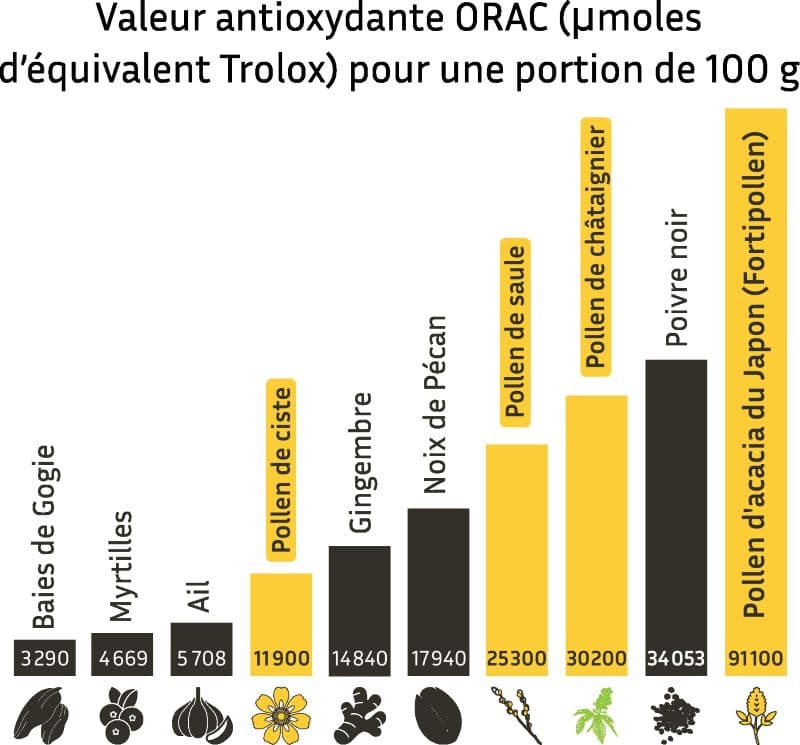
Fortipollen Bio combines the benefits of olive leaves with fresh-frozen Japanese acacia bee pollen. This nutritional complex, preserved and rich in essential micronutrients, helps strengthen and protect the body from the harmful effects of oxidative stress thanks to its exceptional antioxidant capacity: 91,100 μmol per 100g (ORAC measurement)!

Specific properties of Fortipollen BIO

Antioxidant

Fortipollen BIO has an exceptional content of antioxidant molecules (vitamin E, polyphenols). It has a particularly high ORAC score. Antioxidants help protect against free radicals and are key allies for cardiovascular and neurodegenerative protection. By way of comparison, a single tablespoon of Fortipollen BIO bee pollen—or 15 grams of pollen—provides 4 times more antioxidants than 100 grams of goji berries!

Rich in vitamins B1 and B2

Fortipollen organic pollen is naturally rich in vitamin B1, which supports normal heart function. It is also rich in vitamin B2. This vitamin helps reduce fatigue and protect cells against oxidative stress.

Olive leaf

It is renowned for its blood pressure-lowering properties. It also improves circulation by softening and dilating the arteries. It is also known for its blood sugar-lowering, cholesterol-lowering, and diuretic properties.

Ingredients
Ingredients

Organic Japanese acacia pollen (Styphnolobium japonicum), organic olive leaf powder (Olea europaea). Traces of other pollens from the surrounding flora. No artificial colors or preservatives. Japanese acacia pollen grains are harvested in June and July. The predominant flavor is bitter, enhanced by the presence of olive leaf powder. Melt-in-the-mouth texture. Beige color with a few orange specks.

Packaging

250 g tray under protective atmosphere. Origin: European Union. Store in the freezer between -15° and -18° C upon receipt.

Fresh bee pollen is a raw, living, highly complete and complex food that degrades very quickly in the air and at room temperature. Pollenergie packages its pollens using a patented process, combining a controlled atmosphere with freezing, allowing them to travel for 7 days at room temperature without any alteration. Once delivered, the pollen can be safely refrozen to guarantee its full nutritional potential.

Discover our patented process

Can bee pollen be consumed after the expiration date?

Even if the deadline has passed, don't throw away your pollen! It can be safely consumed if it has been kept in the freezer without interruption—even for a whole year! Also, make sure not to leave your tray open to the air for more than 72 hours. If you have any doubts, give the pollen to your plants: mixed with potting soil or compost, it makes an excellent fertilizer!

BBD vs. Use-By Date: The date indicated on our pollens and other products is a Best-Before Date (BBD). It is indicative: after this period, the product presents no health hazard, but may lose flavor or nutritional effectiveness.

Directions for use
Directions for use

Storing fresh bee pollen

As soon as you receive it, place your pollen tray in the freezer to preserve all its nutritional qualities. It is not necessary to defrost the pollen before tasting it. Thanks to its low water content, the pollen remains melt-in-the-mouth and easy to scoop, even when frozen. You can therefore consume it directly out of the freezer.


How to take bee pollen?

Contrary to popular belief, pollen is not more effective on an empty stomach. The ideal way is to consume it during a light meal to help your body better absorb its entire cocktail of nutrients and probiotics. For daily use, one tablespoon is generally sufficient. However, this dosage may vary according to different profiles:

  • Adults: 1 tablespoon (12 to 15 g) per day. This dose can be doubled for athletes or during an intensive 3-week course.
  • Vegetarians & food lovers: up to 4 tablespoons per day without risk of overdose, as pollen is a natural and non-toxic food.
  • Children (up to 12 years old): 1 teaspoon per day. If they ask for more, the child's appetite remains the best indicator of their needs.
  • Sensitive intestines: start with 1 teaspoon per day for a week to avoid the transit-accelerating effect due to fiber, then increase gradually.

Instinct is a good advisor, and wanting to eat more simply means that we need it.


Can bee pollen be taken continuously?

It is often forgotten, but the pollen collected by bees is a food. There is no risk of toxicity in taking it daily—quite the contrary! Pollen consumption is even recommended for people who wish to naturally support chronic health problems or prevent disorders linked to the body's aging. However, its nutritional richness can sometimes saturate the system; a temporary interruption of the course is then recommended to better resume afterwards.


Errors to avoid

Taking pollen on an empty stomach

Consuming bee pollen on an empty stomach

To better enjoy their benefits without discomfort, it is important to consume Aristée pollens preferably during breakfast (or during a light meal / snack) with fresh fruit or compote. Their richness in enzymes and lacto-ferments can indeed cause bloating, flatulence... And they will also be less well assimilated!

Mixing pollen with hot food

Mixing bee pollen with hot food

To preserve the precious lacto-ferments of fresh pollen, never mix it directly with hot food or drinks. Thermal immersion destroys its enzymes. You can, however, consume a hot drink alongside it: the heat dissipates quickly in the stomach, protecting its nutritional qualities. The important thing: do not mix them before ingestion.

Switching bee pollens from one day to the next

To make the most of the benefits of a floral origin, it is important to follow a consistent course for at least 3 weeks. This allows the body to better absorb its richness for better results on vitality, protection, and well-being. You can then choose another floral origin for the following 3 weeks.

Aging of the body
Aging of the body

Free Radicals, What Are They?

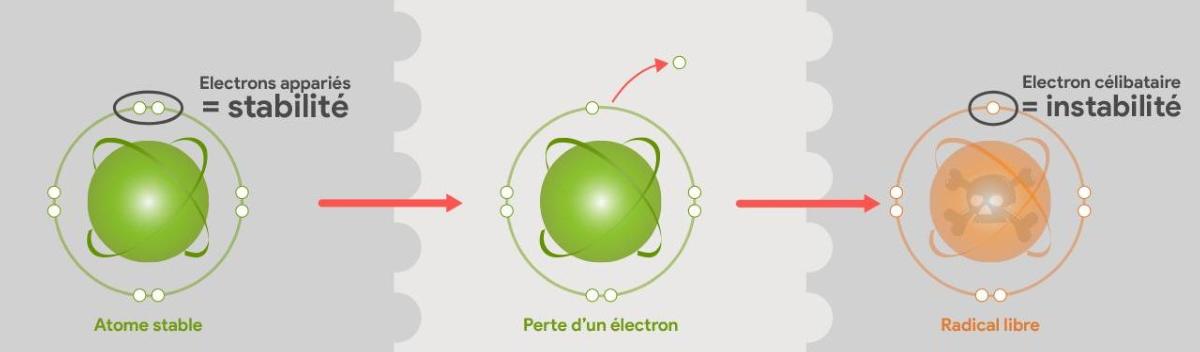
It is a chemical species (atom or molecule) that possesses an unpaired electron, making it unstable and causing high reactivity toward surrounding molecules. It stabilizes itself at the expense of a neighboring molecule, which in turn becomes a free radical, and so on. The phenomenon propagates through chain reactions.

Formation des radicaux libres

Free radicals are naturally present in our body and act based on two factors:

  • Internal factor: free radicals are formed every time our cells use oxygen. Certain situations considerably increase their production: inflammation, chronic stress…
  • External factor: exposure to ultraviolet rays, exposure to pollutants, active and passive smoking…

Free radicals attack all biological materials (DNA, proteins, lipids…) and damage our cell membranes and cells. They are responsible for our aging. Oxidative damage accumulates with age and largely explains why the cells, tissues, and organs of older people are more damaged than those of children. To date, more than 200 diseases are believed to be linked directly or indirectly to oxidative stress: cardiovascular diseases, neurodegenerative diseases, cancers…

Free radicals are also essential for the proper functioning of the body. For example, they are involved in energy production processes. White blood cells use them to eliminate viruses and bacteria. They are also used to destroy old or defective cells, which are then replaced by new ones. The key is to maintain balance. The body produces free radicals, but it also protects itself from them with the greatest care thanks to molecules called antioxidants.

Where Do Antioxidants Come From?

Primary antioxidants are produced by our body. These can be, for example, molecules like glutathione (a powerful cellular detoxifier) or enzymes that need to be in the presence of minerals from food to be activated. Secondary antioxidants are supplied by our diet:

  • Certain vitamins: C, E, as well as B2 (riboflavin)
  • Trace elements: zinc, copper, selenium, and iron, which are necessary to activate protective enzymes
  • Compounds from fruits and vegetables: carotenoids, polyphenols(tannins, flavonoids, anthocyanins, phenolic acids)
  • Compounds from spices and herbs: terpenes.

The ORAC Test

The ORAC index is certainly the most widely used indicator. It measures the antioxidant capacity of a food item. It is calculated using a test of the same name. It is expressed in µmol TE/100g of food, which stands for micromole of Trolox equivalent (the reference antioxidant) per 100g of food. The higher the number, the greater the antioxidant property of the food.

Valeur antioxydante des pollens frais

American nutritionists recommend a daily intake of between 3,000 and 5,000 ORAC units (µmolTE/100g) spread throughout the day in order to keep oxidative stress in the body under control.

Pollen Carotenoids and Polyphenols: A Matter of Synergy

Carotenoids are natural, fat-soluble (soluble in fat) plant pigments found in many foods, flowers, and even algae. They are responsible for their red, yellow, and orange colorations. They can be found notably in carrots, tomatoes, bell peppers, or spinach. And among the best-known carotenoids, we find beta-carotene (cistus pollen), lycopene, lutein, and zeaxanthin (willow and fruit willow pollens).

  1. They help fight oxidative stress and eliminate free radicals that damage our body.
  2. They support immune function by stimulating the immune system's first line of natural or innate defense (white blood cells).
  3. They improve sun tolerance.
  4. They stimulate the production of melanin, the pigment that gives the skin a lovely tanned color.
  5. They counteract the immunosuppressive action of UV rays.

Polyphenols are synthesized by plants and constitute an important group of natural substances found in the plant kingdom. These micronutrients possess highly effective antioxidant properties to counteract reactive oxygen species. They belong to several families that can be broadly classified into flavonoids and non-flavonoids.

The pollens harvested by bees are heavy, sticky, and nutritious for the insect. They are rich in proteins but above all in protective substances to preserve the viability of the plant's male fertilizing cell against environmental aggressions (sun, oxygen) and desiccation. The polyphenol content, and particularly the flavonoid content, is very high in pollen.

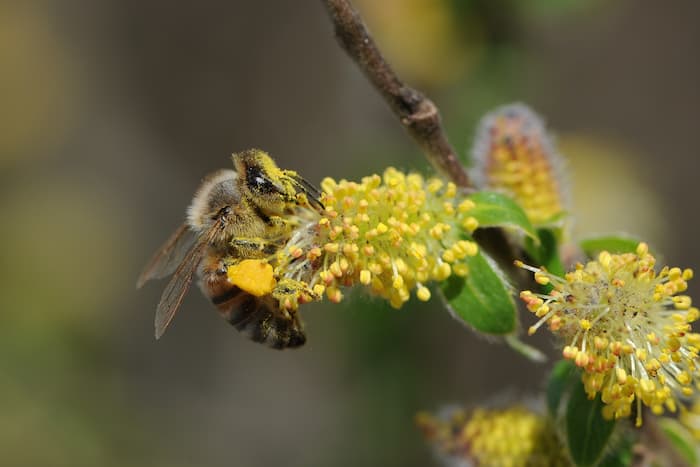
A bee collecting willow pollen

From a therapeutic point of view, a wonderful synergy of polyphenolic compounds and carotenoids can be found in several monofloral pollens. The consumption of fresh frozen willow pollen, which is also known to be rich in zinc, could be essential in the prevention of degenerative eye diseases and prostate inflammation.

Polyphenols and Propolis

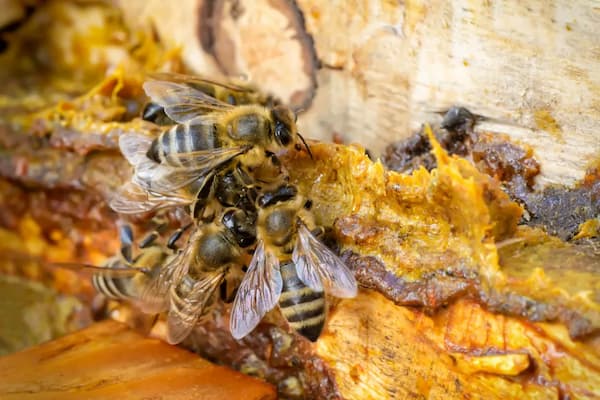
Numerous studies have shown that propolis is an important source of polyphenols, particularly flavonoids. Around thirty compounds have been identified, including flavones, flavonols, and flavanones; examples include chrysin, quercetin, pinocembrin, and galangin. Bacteriostatic effects have been attributed to pinocembrin (a flavone) and galangin. Bees thus instinctively employ the properties of polyphenols to "sanitize" their hive.

Bee propolis in the hive

Polyphenols are found in the bud secretions of many trees such as birch, poplar, and fir. The chemical composition of propolis can therefore vary significantly, depending directly on the source foraged as well as geographic and climatic conditions. For example, propolis coming from Europe, South America, or Asia has different compositions and polyphenol contents, resulting in different antioxidant properties.

All studies point in the same direction and emphasize that hive products (propolis, pollen, and honey) must now be considered as a potential dietary source of antioxidants, and no longer simply as food with high nutritional value.

Customer reviews
Customer reviews
Data sheet
Data sheet
  • Product Type
    Fresh pollen
  • My needs
    Malnutrition and deficiencies
    Antioxidants
    Sport
  • Label
    Certifié bio

You might also like

Loading...
Back to top