A formula specially developed to relieve digestive discomfort. Ideal for regaining a... [Read...]
Fesh chestnut and bramble bee pollen (Organic)
This organic bee pollen is recommended for people who are anxious, stressed, or mildly depressed. It is naturally rich in vitamin B6, polyphenols, and tryptophan, an amino acid that is a precursor to serotonin. It is also recommended during the recovery phase for professional and amateur athletes. 250-g container; store in the freezer upon receipt.
Read more- Free delivery from €65 in France
- In stock (103)
-
At home on monday 5 october 2026info
- Help and advises 05 53 68 11 11
- 20 years old french manufacturer
Balls for peaceful days
One of the important factors of aging is the gradual decrease in the cells' ability to fight against oxidation. Highly rich in antioxidants, fresh-frozen organic chestnut and bramble pollen actively protects cells against oxidative stress. In case of persistent fatigue, overwork, or mental exhaustion.
Specific properties of chestnut and bramble bee pollen
Antioxidant
Organic chestnut and bramble pollen features some of the highest antioxidant values in the ORAC test (measurement of a food's antioxidant capacity) within the pollen, fruit, and vegetable category. Antioxidants help protect against free radicals and are key allies for cardiovascular and neurodegenerative protection.
Relaxation and serenity
Organic chestnut and bramble pollen is rich in antioxidants, molecules that fight against free radicals. Tryptophan, an amino acid precursor to serotonin, is involved in regulating mood and anxiety.
Nervous system
A source of vitamin B6, organic chestnut and bramble pollen contributes to the normal functioning of the nervous system.
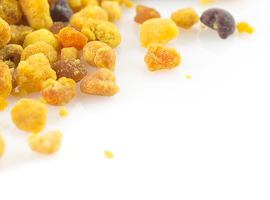
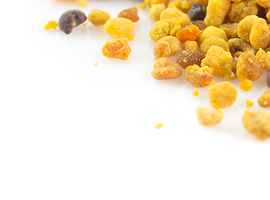
Organic chestnut pollen (Castanea sp.), organic blackberry pollen (Rubus sp.). Traces of other pollens from the surrounding flora. No artificial colors or preservatives. The pollen grains from the wild chestnut tree are harvested between June and July. A mild flavor dominated by honey with slightly bitter notes on the finish. A melt-in-the-mouth texture, soft and velvety. Golden yellow and olive green pollen grains.
Packaging
250 g tray under protective atmosphere. Origin: European Union. Store in the freezer between -15° and -18° C upon receipt.
Fresh bee pollen is a raw, living, highly complete and complex food that degrades very quickly in the air and at room temperature. Pollenergie packages its pollens using a patented process, combining a controlled atmosphere with freezing, allowing them to travel for 7 days at room temperature without any alteration. Once delivered, the pollen can be safely refrozen to guarantee its full nutritional potential.
Can bee pollen be consumed after the expiration date?
Even if the deadline has passed, don't throw away your pollen! It can be safely consumed if it has been kept in the freezer without interruption—even for a whole year! Also, make sure not to leave your tray open to the air for more than 72 hours. If you have any doubts, give the pollen to your plants: mixed with potting soil or compost, it makes an excellent fertilizer!
BBD vs. Use-By Date: The date indicated on our pollens and other products is a Best-Before Date (BBD). It is indicative: after this period, the product presents no health hazard, but may lose flavor or nutritional effectiveness.
Storing fresh bee pollen
As soon as you receive it, place your pollen tray in the freezer to preserve all its nutritional qualities. It is not necessary to defrost the pollen before tasting it. Thanks to its low water content, the pollen remains melt-in-the-mouth and easy to scoop, even when frozen. You can therefore consume it directly out of the freezer.
How to take bee pollen?
Contrary to popular belief, pollen is not more effective on an empty stomach. The ideal way is to consume it during a light meal to help your body better absorb its entire cocktail of nutrients and probiotics. For daily use, one tablespoon is generally sufficient. However, this dosage may vary according to different profiles:
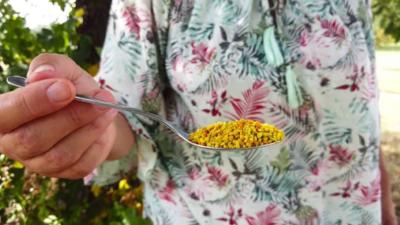
- Adults: 1 tablespoon (12 to 15 g) per day. This dose can be doubled for athletes or during an intensive 3-week course.
- Vegetarians & food lovers: up to 4 tablespoons per day without risk of overdose, as pollen is a natural and non-toxic food.
- Children (up to 12 years old): 1 teaspoon per day. If they ask for more, the child's appetite remains the best indicator of their needs.
- Sensitive intestines: start with 1 teaspoon per day for a week to avoid the transit-accelerating effect due to fiber, then increase gradually.
Instinct is a good advisor, and wanting to eat more simply means that we need it.
Can bee pollen be taken continuously?
It is often forgotten, but the pollen collected by bees is a food. There is no risk of toxicity in taking it daily—quite the contrary! Pollen consumption is even recommended for people who wish to naturally support chronic health problems or prevent disorders linked to the body's aging. However, its nutritional richness can sometimes saturate the system; a temporary interruption of the course is then recommended to better resume afterwards.
Errors to avoid
Consuming bee pollen on an empty stomach
To better enjoy their benefits without discomfort, it is important to consume Aristée pollens preferably during breakfast (or during a light meal / snack) with fresh fruit or compote. Their richness in enzymes and lacto-ferments can indeed cause bloating, flatulence... And they will also be less well assimilated!
Mixing bee pollen with hot food
To preserve the precious lacto-ferments of fresh pollen, never mix it directly with hot food or drinks. Thermal immersion destroys its enzymes. You can, however, consume a hot drink alongside it: the heat dissipates quickly in the stomach, protecting its nutritional qualities. The important thing: do not mix them before ingestion.
Switching bee pollens from one day to the next
To make the most of the benefits of a floral origin, it is important to follow a consistent course for at least 3 weeks. This allows the body to better absorb its richness for better results on vitality, protection, and well-being. You can then choose another floral origin for the following 3 weeks.
Why Are We Stressed?
However, in our current civilization, we are not constantly in "life-threatening" danger; yet, numerous stressful elements surround us. These elements most often stem from our daily activities and lifestyle: work, raising children, pressure to meet goals, financial difficulties, difficult marital relationships…
All of these situations do not necessarily cause major stress, but rather a moderate, cumulative, and continuous stress that ultimately disrupts the body's natural balance. When this stress manifests continuously, it can lead to a wide variety of more or less interconnected disorders, such as on a physiological level: accelerated aging, nutritional deficiencies, immune deficiencies, psychiatric problems, psychosomatic illnesses, worsening of medical conditions, and on a social level: disruption of personal and professional life with sleep, learning, and concentration disorders, as well as a reduced capacity to adapt, drawing the individual into a downward spiral.
From a physiological point of view, the organism can be seen as a system in balance, known as "homeostasis." Every stressor that disrupts this balance forces the organism to implement adaptations to restore equilibrium and ensure its survival. Our cerebral, cognitive, and emotional balance is regulated by the combined action of neurotransmitters (including acetylcholine, serotonin, melatonin, dopamine, and adrenaline). These are involved in regulating mood, sociability, thermogenesis (serotonin), sleep regulation (melatonin), motivation, self-esteem, reward, pleasure or libido (dopamine), and the regulation of autonomic neuromotor activity (acetylcholine).

Any element whatsoever (food substrate deficiency, exogenous stressor, illness, etc.) that disrupts this balance between neurotransmitters will lead to harmful consequences for the body. The total accumulated daily stress results in an elevation of cortisol levels in the blood. When present in too high a quantity over long periods, this molecule will lead to a slowing of bone formation, an inhibition of inflammatory responses, a weakening of the immune system, and an inhibition of neurotransmitter transmission within the central nervous system. Thus, we know for example that depressed individuals have higher blood cortisol levels than normal and, at the same time, lower serotonin levels than normal. It is therefore essential to help our body as much as possible to regulate its neurotransmitter levels.
The Positive Power of Beehive Products
To look on the bright side of life, it is essential to give the body the right fuels that will allow it to feel alert, both physically and mentally. Favoring high-quality foods is fundamental for morale. Stress, frustration, depression, anxiety—now is the time for a good course of superfoods like fresh bee pollens combined with royal jelly to put an end to gray mornings!
The transmission of nervous information between two neurons occurs through neurotransmitters. They are synthesized by the presynaptic neuron and stored in vesicles. These vesicles release their contents into the synaptic cleft. These neurotransmitters then bind to specific receptors on the postsynaptic neuron, thereby ensuring the transfer of information for a few milliseconds. After carrying out their action, the neurotransmitters released from their receptors are either recaptured by the presynaptic membrane or degraded in the synaptic cleft by specific enzymes: Monoamine Oxidases (MAO).
Depressive states are known to be characterized by too low a concentration of neurotransmitters in the synaptic cleft. Current medicinal solutions for these disorders involve using molecules that inhibit these enzymes, thereby allowing these neurotransmitters a longer window of action. One study showed that honey, fresh chestnut bee pollen, and propolis exerted an inhibitory action on these MAOs. Another in vivo study demonstrated that an oily extract of green propolis from Baccharis Dracunculifolia exerted an "antidepressant and anxiolytic-like" action on the behavior of animals subjected to acute stress.
Why are pollens beneficial?
Pollens are rich in plant proteins and contain all essential amino acids. Neurotransmitters are synthesized from elements contained in these amino acids. They cannot be synthesized by the body and must therefore be provided through diet. The quantitative level of these neurotransmitters is directly correlated with specific psychological disorders such as depression, irritability, and memory loss.
- Tryptophan, an amino acid that cannot be synthesized by the body, is the precursor to serotonin. Insufficient levels can be responsible for nervousness, aggressiveness, and anger. Pollens richest in tryptophan: chestnut and hawthorn.
- Phenylalanine is then transformed into tyrosine (a precursor to dopamine and noradrenaline), two neurotransmitters that stimulate the brain. Pollens richest in phenylalanine: chestnut, hawthorn, willow, and fruit willow.
- Methionine is essential for the proper functioning of all other neurotransmitters. Pollens richest in methionine: hawthorn, Nutripollen, Effipollen Digestive Harmony, and heather.

Pollens are rich in B-group vitamins (as is royal jelly). They play a major role in energy production and the health of the nervous system. Beyond physical issues, their deficiency inevitably leads to many nervous and behavioral dysfunctions. They are often degraded by food preservation and cooking conditions, which makes their presence in industrial food highly unpredictable!
| B Vitamins | Role in nervous balance | Richest pollens |
|---|---|---|
| B1 | Effect on depression and fatigue | willow / fruit willow / hawthorn |
| B3 | Effect on the transmission of nerve impulses and a significant effect on mood | cherry / willow / fruit willow / kidoupollen fortifying |
| B5 | Helps the proper functioning of the nervous system. Anti-stress action | willow / fruit willow / kidoupollen fortifying / chestnut |
| B6 | Anti-stress and anti-depressant action | hawthorn / chestnut |
| B9 | Promotes emotional balance | cherry / hawthorn |
Hawthorn pollen, rich in vitamin B6, has an anti-stress and anti-depressant action that is essential for the formation of thoughts, emotions, and coordination. It is also rich in tryptophan, the precursor to serotonin, also known as the good mood hormone.
Chestnut pollen is a source of potassium and rich in vitamins B2 and B3, which contribute to the normal functioning of the nervous system. Stress stimulates energy metabolism and therefore generates an excess requirement for vitamins B2 and B3 to meet this stimulation. A deficiency in these vitamins can lead to disruptions in the normal functioning of the nervous system. This pollen is also rich in vitamin B6, which contributes to normal psychological functions, and provides the body with tryptophan, an amino acid precursor to serotonin involved in regulating mood and anxiety.
Why take royal jelly in case of stress?
Royal jelly is also rich in B-group vitamins and contains acetylcholine, which exerts a very favorable action on the sympathetic and parasympathetic nervous systems. It will boost the transmission of nervous information, which is responsible for concentration and memory! It is also one of the richest foods in vitamin B5, pantothenic acid, which helps the proper functioning of the nervous system. Royal jelly also helps to regain a good energy level when exhausted, to relax, and to sleep better when stressed. As an adaptogen, it helps the body adapt to various situations likely to disrupt its functioning.
-
My needsConstipation
Intestinal balance
Inflammatory diseases
Detox
Dietary rebalancing
Antioxidants
Physical and mental fatigue
Stress and morale
Children and adolescents
Pets
Français
English